Speaking their language: Writing for Gen Z

by Brian Bardelli
Is there a problem with how we explain the law to younger generations?
Explaining the law to young people is not simply a problem of oversimplifying vocabulary. It is a problem of simplifying the language while retaining the same relevance and trust. A reader who does not see a connection between a legal idea and their own life has little to no reason to keep reading, regardless of the quality of the written work. For anyone writing about legal topics to Gen Z, including counterfeiting and counterfeit goods, the question is therefore not only what to say, but also who is saying it and how the information connects to the audience’s life.
Here we try to break down two lessons on how to tailor your message to reach Gen Z.
Lesson One: Peers Carry More Weight Than Institutions
The first lesson comes from how young people assess information. The Edelman Trust Barometer, an annual global study produced by the Edelman Trust Institute that examines how people build, lose, and regain trust in institutions, found that 58% of Gen Z individuals in the UK trusted social media posts from friends as much as, or more than, traditional journalism. For legal writers, this suggests that authority alone is not sufficient to carry a message anymore. Peer voices can be more persuasive and appealing than institutional ones, which helps explain why youth-led efforts can make difficult topics more digestible and directly relevant.
Peer-led programs such as GenZAgainstFakes represent the potential of youth-centered approaches to legal awareness, especially as younger generations become increasingly drowned in information on social media platforms. Content that feels like a conversation between peers, rather than a formal lecture from a textbook – or worse: a telemarketer, is more likely to capture the attention of young students and encourage its spread.

Time to leave the telemarketer and salesy language behind.
Lesson Two: Use Real Life Examples
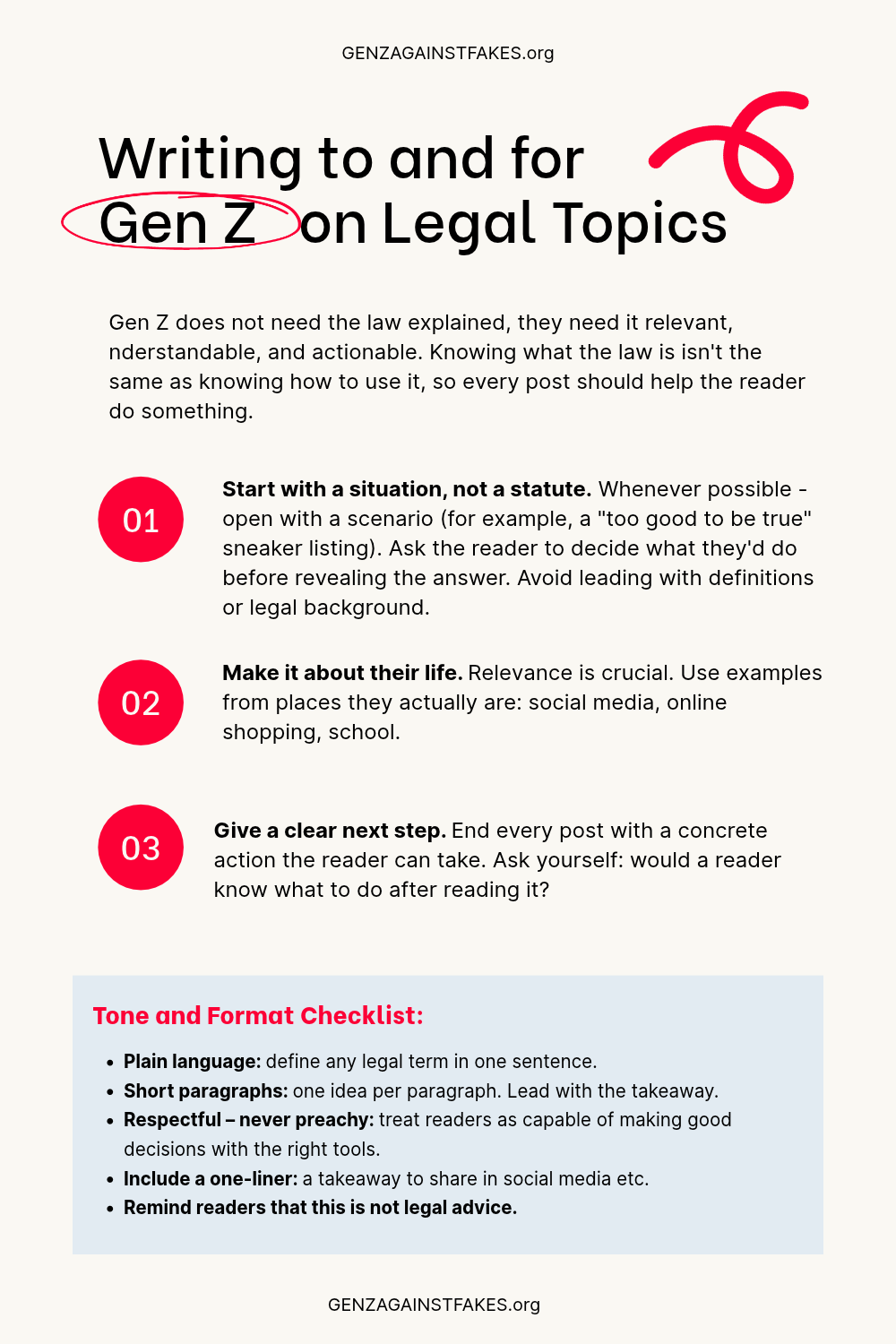
The second lesson is that knowing the law is not the same as knowing how to apply it. A young person can understand a legal principle and still have no idea what to do when that principle appears in their own life. Legal writing for young students should therefore begin with a situation rather than a decree: a suspiciously cheap online listing, a lease waiting to be signed, or a message asking for money.
Instead of presenting the law as a collection of rules to memorize, writers can turn those rules into tools that apply to problems readers can recognize. Ask a reader what they would do before giving them the answer; then law becomes something they have to think through rather than an intimidating topic they are simply told to remember. This is also the approach utilized by the community-based, student-led project called The Next Bench Project, where students face scenarios that encourage them to apply legal concepts, weigh their options, and choose a course of action. The goal is not only to know the rule, but also to know why the rule matters and what to do when it presents itself.
“These points should be considered as developing hypotheses; the performance of published content can provide evidence about which approaches actually engage and persuade readers.”
Applied to counterfeit goods, this suggests emphasizing consequences that readers can personally relate to, such as losing money, receiving an unsafe product, or becoming the victim of a scam, rather than focusing primarily on the abstract side of the intellectual-property doctrine. It also means treating young readers and students as capable consumers who can and should be able to learn how to recognize suspicious goods and sellers, instead of treating them as people who need to be scolded for making mistakes.
One final tip:
Every piece of legal writing for young people should end with a call to action for the reader. That might mean checking a seller’s reviews, saving a receipt, reporting suspicious listings, or contacting legal-aid organizations. Effective legal communication with Gen Z and the younger population makes the law less intimidating and more understandable. Most importantly, it helps young people to see the law as a tool they can use to navigate situations they encounter in everyday life rather than a sermon given by a lawyer.
* Brian Bardelli is a high school student and founder of The Next Bench Project, a student-led initiative focused on practical legal education and career exposure for young people. He is also involved in youth-focused intellectual property education through GenZAgainstFakes.